ETH Zürich · Carnegie Mellon · EPFL
Jonathan Fouquet
Reinforcement Learning, Optimal Control & Legged Locomotion
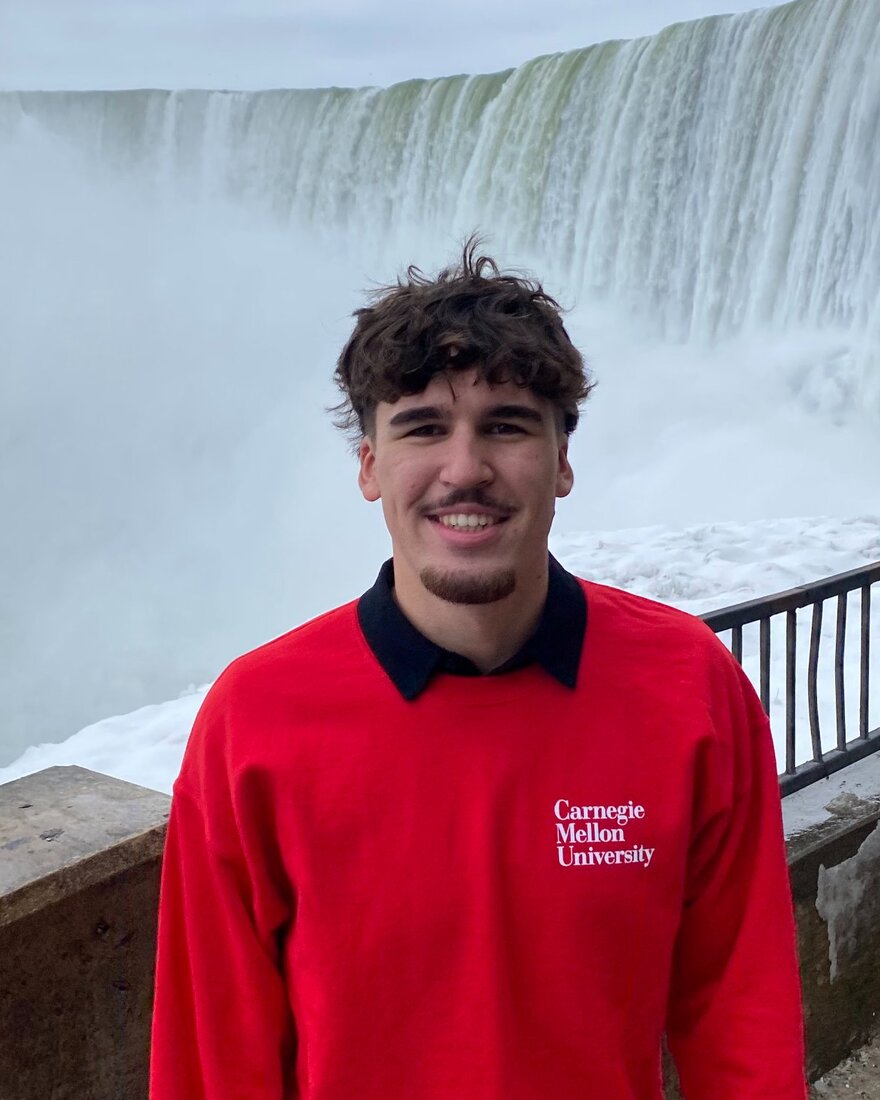
I am an M.Sc. student in Robotics, Systems and Control at ETH Zürich, motivated by one central challenge: teaching legged and humanoid robots how to move with agility, balance, and whole-body coordination in the physical world.
My research focuses on the seam between reinforcement learning (PPO, reward design, sim-to-real transfer) and model-based optimal control (MPC, LQR, receding-horizon planning). I am convinced that robust physical autonomy emerges when we combine the adaptive power of learned policies with the mathematical stability guarantees of dynamic models.
At ETH Zürich, I conduct coursework advised within the Robotic Systems Lab (RSL / Prof. Marco Hutter) and build the evaluation suite for learned humanoid walking policies on the software team of the ETH Robotics Club.
◰ Zürich, Switzerland · German (Native) · French (Native) · English (Proficient)
01 / Research Focus
What I want to solve in robotics.
Building embodied AI systems that do not merely memorize simulation, but adapt gracefully to unpredictable terrain and physical contact.
RL for Legged Locomotion
Training robust whole-body motor skills in physics simulators (MuJoCo, Isaac Lab) for quadrupeds and humanoids. Designing curriculum learning, reward shaping, and domain randomization so policies survive the jump to real hardware.
Model-Based Control & MPC
Using Model Predictive Control, LQR, and Dynamic Programming as stabilizing backbones. Combining optimization-based trajectory planning with learned policies to preserve hard constraints and safety bounds.
Human–Robot Interaction & Teleoperation
Closing the control loop back to the human operator: mapping VR headset and hand-tracking input to whole-body humanoid motion, and managing low-latency bilateral feedback under delayed packet transmission.
02 / Selected Projects
Current work & robotic implementations.
Hands-on systems spanning humanoid policy evaluation, learning-based control, and classical feedback control loops.
Robot Apprentice — learn from the expert, teach the novice
AI flight-inspection copilot · Learning from demonstration + Guardian MPC
An AI “apprentice” that learns inspection-flight rules by watching an expert, explains each rule back to confirm it understood, then coaches a novice using the expert’s own words. A Guardian MPC predicts about two seconds ahead and brakes to keep the aircraft inside the expert’s safety envelope. Built end-to-end in a 24-hour hackathon.
ETHRC Humanoid — RL Policy Evaluation
Software Team · Isaac Lab / Python
Building the evaluation suite that tests the club’s learned humanoid walking policies for robustness before they run on hardware.
- Extended the terrain and friction sweep with sideways walking and turning on slippery ground.
- Built a lighting and sensor-ablation sweep that checks whether the robot’s cameras and lidar can still track the scene in low light or with a sensor removed.
Robotics Labs — Autonomy, Estimation & Control
Hands-on robotics labs · 16-311 Introduction to Robotics
A semester of ground-robot and manipulator labs on Raspberry Pi hardware, spanning perception, state estimation, planning, and feedback control.
- Bayesian localization — fusing lidar range readings to detect obstacles and estimate pose while line-tracking under PID control.
- Self-balancing (inverted-pendulum) robot stabilized from IMU feedback with a PID loop.
- 2-joint planar arm with forward/inverse kinematics and configuration-space (C-space) path planning around obstacles.
- Computer-vision goalkeeper tracking a ball via an onboard camera, plus a camera-equipped search-and-rescue platform.
- Reflectance-sensor line-following courses and maze navigation; Grade A (4.0 / 4.0) across all robotics & control coursework.
Inverted Pendulum Optimal Control
Nonlinear Modeling & Kalman Filter Design
Modeled the nonlinear cart-pole dynamics and evaluated frequency-domain vs. state-space control methods.
- Conducted root-locus and Bode analysis to define stability margins and pole-placement objectives.
- Formulated continuous and discrete Linear Quadratic Regulators (LQR) to maximize disturbance rejection.
- Implemented a Kalman Filter to reconstruct states from noisy sensor streams in MATLAB/Simulink.
03 / Academic Background
Relevant training across robotics, control, and quantitative analysis.
I have built my foundation across ETH Zürich, Carnegie Mellon, and EPFL, with a focus on dynamics, optimization, control, and autonomy rather than broad general coursework.
ETH Zürich
M.Sc. Robotics, Systems and Control · RSL (Prof. Marco Hutter)
| Current course · Autumn 2026 | Area | ECTS |
|---|---|---|
| Robot Dynamics | Dynamics | 4 |
| Model Predictive Control | Control | 4 |
| Dynamic Programming & Optimal Control | Control | 4 |
| Probabilistic Artificial Intelligence | AI / ML | 8 |
| Planning & Decision Making for Robots | Autonomy | 4 |
| Image Analysis & Computer Vision | Perception | 6 |
Carnegie Mellon University
Exchange Year · Mechanical Engineering & Robotics
| Course | Area | Grade |
|---|---|---|
| General Robotics | Autonomy | A |
| Feedback Control Systems | Control | A |
| Probability Modeling | Statistics | A |
EPFL
B.Sc. Mechanical Engineering
| Course | Type | Grade |
|---|---|---|
| Numerical Analysis | Mathematics | 6.00 |
| Dynamical Systems | Dynamics | 5.75 |
| Probability & Statistics | Statistics | 5.75 |
| Linear Algebra | Mathematics | 5.75 |
| Programming for Engineers | Programming | 5.75 |
| Information, Computation & Comm. | Computer Science | 5.50 |
04 / Experience
Work & engineering history.
Industry internships, software development, and academic coaching.
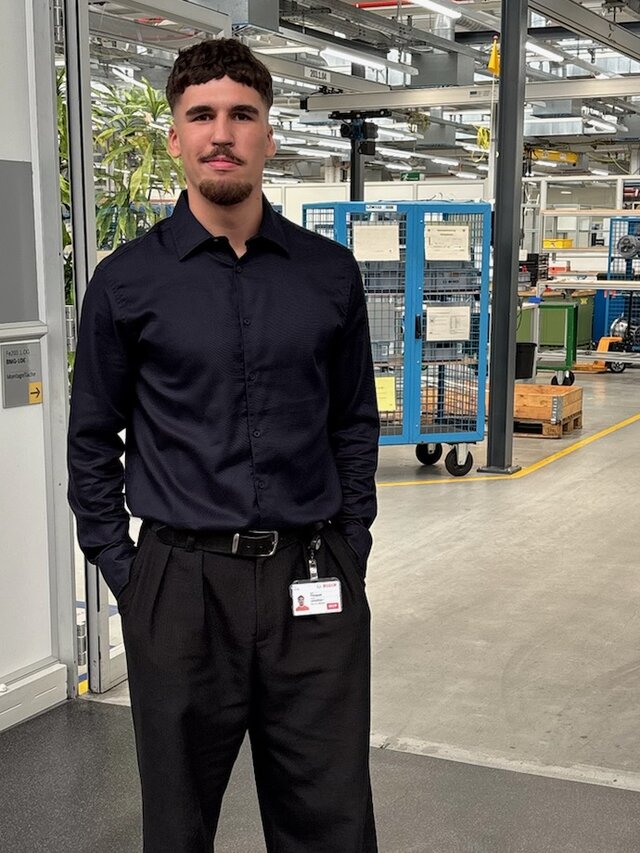
Bosch — Special Machinery Construction
May – Sep 2026 · Stuttgart, GermanyEngineering & AI Intern
Engineered an end-to-end custom Retrieval-Augmented Generation (RAG) platform — Python, LangChain and ChromaDB behind a FastAPI backend and Streamlit frontend — to bring LLMs into corporate workflows and support the SAP S/4HANA migration, automating data extraction from Confluence, Jira, PDFs and Excel. On the hardware side, designed custom special-machinery components and technical drawings in Autodesk Inventor with rapid 3D-print prototyping, also working with Kuka industrial robots.
Virtual Traffic Lights
Jun 2025 – Apr 2026 · Pittsburgh, USASoftware Developer
Built backend FastAPI endpoints securing real-time data streams — red-light-running incidents and historical vehicle turn counts — for an intelligent traffic-monitoring platform. Created React / TypeScript visualization components and containerized deployments with Docker.
EPFL (École Polytechnique Fédérale de Lausanne)
2024 – 2025 · Lausanne, SwitzerlandTeaching Assistant · Mechanical Engineering
TA across three courses: Information, Computation & Communication (C programming, Prof. Tomozei) and Electrical Science & Technology labs for Mechanical, Micro- and Materials Engineering (Prof. Allenbach). Guided students through algorithmic debugging, supervised lab experiments, and graded examinations.
05 / Toolkit
Technical stack.
Tools and frameworks I leverage across physical simulation, control theory, and hardware.
Methods & Theory
- Reinforcement Learning (PPO)
- Model Predictive Control (MPC)
- Optimal Control & LQR
- Kalman State Estimation
- Rigid-Body Dynamics
- Probabilistic AI / Bayesian
Robotics & Sim
- ROS 2 (Humble / colcon)
- MuJoCo
- Isaac Lab / Isaac Sim
- URDF / MJCF Modeling
- Raspberry Pi · Arduino
Programming
- Python (PyTorch, NumPy)
- C / C++
- MATLAB & Simulink
- TypeScript / React
- Bash / Shell scripting
Hardware & Tools
- Autodesk Inventor
- Fusion 360 · CATIA
- Git · GitHub
- Docker · Linux
- Rapid Prototyping / 3D Print
06 / Contact
Let's build intelligent robots.
I am currently open to part-time working-student positions (20–40%) and robotics research internships in Zürich. If you are developing locomotion policies, whole-body controllers, or physical AI systems, let's connect.
jfouquet@ethz.ch